

South Africa’s working class has been delivered yet another grim reminder that this economy is not recovering. It is collapsing on top of the poor. Anyone celebrating today is celebrating a national tragedy.
Stats SA’s labour force data confirms what workers have long known: unemployment is deepening, deindustrialisation is accelerating, and inequality is hardening into a permanent condition. SAFTU will not allow anyone to sanitise these figures.
Our position is firm: the expanded unemployment rate is the only real measure of joblessness in this country.
The crisis is staggering:
• Black African expanded unemployment stands at 47.5 percent,11.532 million people.
• Black African women face an expanded unemployment rate of 51.4 percent, the highest of any group in the country.
• Youth (15–34) expanded unemployment remains above 50 percent, creating a generation locked out of work, income, and hope.
This is not a temporary downturn. It is structural. It is political. And it flows directly from the fact that, 31 years into democracy, the South African economy remains essentially unchanged from its colonial–apartheid structure.
A colonial economy reproduced in a democratic era.
SAFTU has consistently warned that the post-1994 economic path did not transform the foundation of the economy. Instead of breaking with the past, the democratic state preserved:
• An extractive, export-driven economic model
• A minerals-energy complex controlled by large capital
• A capital-intensive, low-employment production structure
• Extreme wealth concentration
• A labour market rooted in cheap, insecure Black labour.
By abandoning the Freedom Charter’s programme of “growth through redistribution” and embracing trickle-down economics, GEAR, and the Washington Consensus, the government entrenched the very inequalities it promised to dismantle.
The result is an economy unable to absorb labour, unable to industrialise, and unable to deliver dignity.
Extractivism: exporting our minerals and exporting our jobs
South Africa remains locked in a raw-material export trap.
We dig minerals out of the ground and ship them unprocessed to China and other Asian economies.
This means we:
• Export raw materials
• Import finished products
• Export jobs that should be created here
This extractives model prevents beneficiation, blocks industrialisation, depletes our stock of non-renewable natural resource wealth, pollutes our land, air, and water, enforces the super-exploitative migrant labour system, and locks us into the position of supplying cheap inputs to foreign industries while our own factories shut down.
Deepening deindustrialisation and idle productive capacity
Manufacturing now contributes barely 13 percent of employment, an astonishing collapse for an economy that was once industrialising. Industrial parks stand half-empty. Machines sit idle. Entire production lines gather dust. In the 1980s, manufacturing/GDP was always 22-24% but after the early-1990s economic depression and the decision to join the World Trade Organisation on disadvantageous terms in 1994, there was a steady crash.
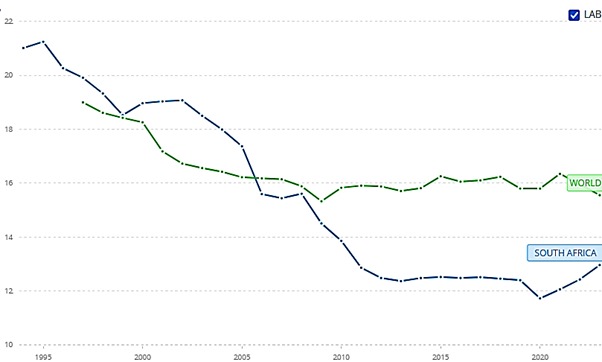
At the same time, South African corporations are hoarding over R1.8 trillion in cash, refusing to invest in productive capacity. This is not an accident. It is a strategic choice by capital, enabled by a state that refuses to discipline capital or redirect investment toward national development.
The consequences speak for themselves: factory closures have surged to historic levels, rising above 23 percent year-on-year, according to CCMA-linked closure and liquidation data. This is the highest rate recorded in democratic South Africa. The 2025 closures of plants or other forms of downsizing reflect an utterly failed industrial policy, a so-called ‘slowbalisition’ in export markets, and a stagnant consumption base:

Some of the damage to manufacturing is external, beyond control. In February 2025, smelted metals destined for the U.S. were hit with 25-50% tariffs, followed by a 30% general tariff imposed by Donald Trump in August 2025 that especially affected citrus, nuts and vineyard products. Only raw minerals and energy products were given the same 0%-tariff that most exports had enjoyed under the prior 2000-25 African Growth and Opportunity Act. The export of $4.1 billion in duty-free products in 2024 had included $1.92 billion in automobiles, $1.0 billion in steel and aluminium, and $540 million in chemicals and machinery; by the middle of this year, reports emerged of dramatic year-on-year monthly declines in excess of 50% for most such sales.
This is not a “skills mismatch” or a “structural adjustment”. It is economic demolition.
Neoliberalism dressed up as reform: Operation Vulindlela and GAIN
Instead of responding with a bold industrial strategy, public investment, and redistribution, the state has doubled down on neoliberalism.
Instead of tackling Trump by working closely with BRICS leaders at the September 8 special conference called by Brazilian President Lula da Silva, President Ramaphosa and Trade Minister Tau have been unsuccessfully begging Trump for relief on an individual basis, even agreeing to import vast new methane gas supplies and poultry (the parts that U.S. consumer don’t want to eat).
And as a result of the U.S. trade war on China, that economy’s vast overcapacity has been displaced to South Africa. There has been an upsurge in 2025 of Chinese ‘dumping’ (selling below the cost of production) for steel, tyres, washing machines, and nuts and bolts, requiring the imposition of protective tariffs against China, by the International Trade Administration Commission. However, as most leaders from these sectors would agree, it is a case of too little, too late.
Furthermore, the Treasury is doubling down on policies that, since 1994, have failed to deliver results.
Like the 1996 GEAR and 2000s ASGISA and National Development Plan, the recent Operation Vulindlela and newly-imposed GAIN are simply privatisation, deregulation, outsourcing, austerity, and market-driven restructuring in new packaging.
These “reforms” shrink the state, commodify public services, and entrench corporate power. They accelerate the collapse, affecting workers from municipal services to education to health.
Inflation targeting: the tail wagging the dog.
SAFTU notes that inflation targeting was originally adopted by the government, not the Reserve Bank acting alone. But what is happening now is even more dangerous: the push toward a de facto 3 percent inflation target is being driven aggressively by the Reserve Bank Governor, who has rallied financial markets behind this agenda long before the public, Parliament, or Cabinet had any mandate to support it.
This is a classic case of the tail wagging the dog.
Instead of democratic policy setting monetary direction, unelected technocrats are now determining national economic strategy. Treasury has been forced to follow the financial markets that the Governor himself energised.
A lower 3 percent target guarantees permanently high interest rates, which:
• Strangle the real economy
• Suppress investment
• Worsen factory closures
• Increase household debt
• Suffocate small businesses
• Further depress industrial demand
• Deepen unemployment
High interest rates in a deindustrialising economy do not fight inflation — they fight workers.
Austerity and scapegoating
While millions are jobless, the Treasury continues to impose austerity: freezing posts, cutting infrastructure budgets, eroding municipal capacity, collapsing the health system, and shrinking education.
This is deliberate underdevelopment.
At the same time, politicians resort to cheap xenophobic scapegoating, blaming migrants for unemployment instead of confronting capital, austerity, and corruption. Migrants did not deindustrialise South Africa. Migrants did not loot PRASA, Eskom or Denel. Migrants did not relocate factories offshore. Migrants did not hoard R2 trillion.
The crisis comes from power, not from below.
SAFTU’s call
South Africa is at a crossroads.
The expanded unemployment crisis, collapsing industries, extractive economy, shrinking state, and neoliberal policy direction leave us no illusion: there is nothing to celebrate.
SAFTU calls for:
• A decisive break with neoliberalism, Operation Vulindlela, and GAIN
• A new, state-led industrialisation drive
• Beneficiation and rebuilding of the secondary industry
• Massive public employment programmes
• Filling all vacant posts in education, health, policing, water, and municipal services
• An end to outsourcing and labour broking
• A universal basic income grant
• Redistribution of wealth in line with the Freedom Charter
• Public mobilisation to challenge austerity and reclaim economic sovereignty
South Africa’s future cannot be built on austerity, extractivism, financialised power, and mass unemployment.
It must be built by and for the working class.
SAFTU will continue to organise, mobilise, and fight alongside workers and communities to reclaim this economy from those who have captured it.
A statement was issued on behalf of SAFTU General Secretary Zwelinzima Vavi.
For media inquiries, contact the National Spokesperson at
Newton Masuku at:
Newton@saftu.org.za
078 5174094
Media Officer
Asive Dyani
0719019564


